Vitamin · 20 mcgVitamin D3
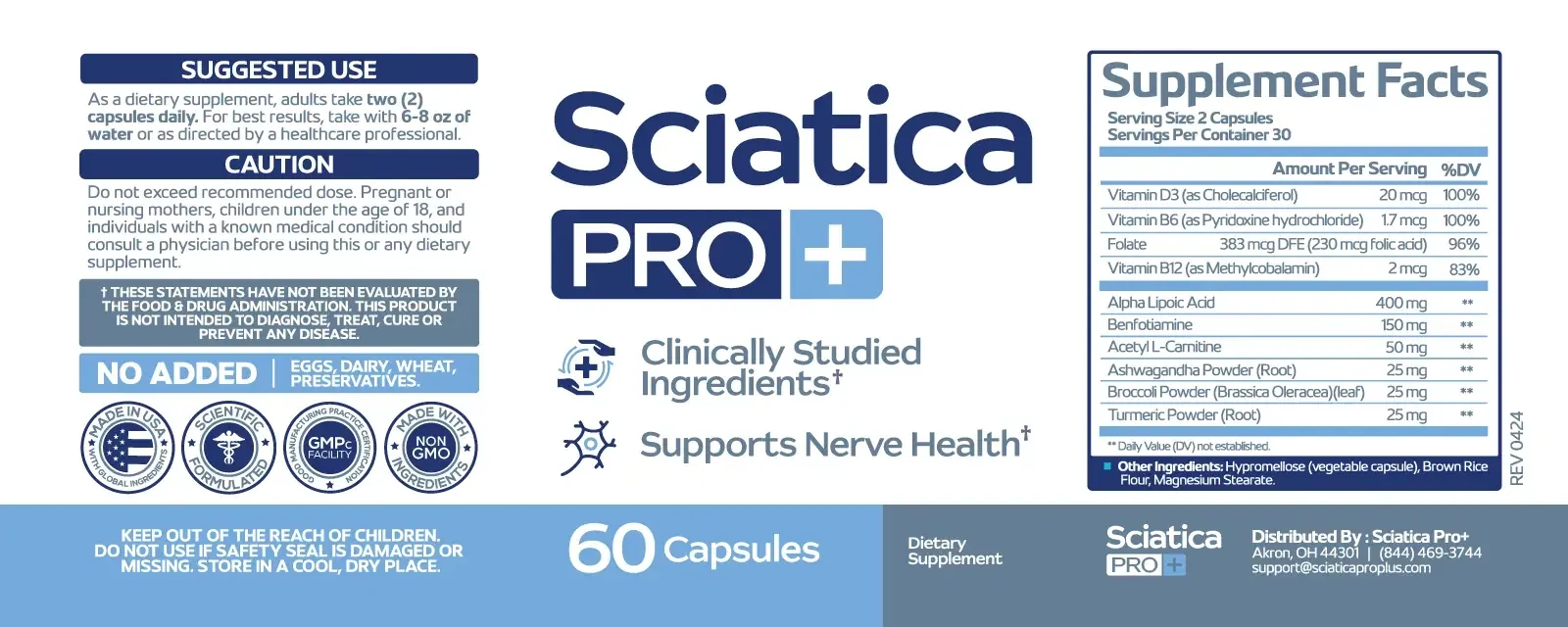
as cholecalciferol · 100% of the Daily Value
- Cholecalciferol, the form your skin makes from sunlight and the form used in most supplements.
- 20 mcg is 800 IU, which is 100% of the Daily Value and an ordinary supplement amount.
- Low vitamin D is genuinely common, particularly in winter, in older adults and in people who cover up or stay indoors.
- Its connection to nerve pain is weak and indirect; its connection to muscle and bone is not.
- If you are deficient, correcting that is worth doing. A blood test tells you; a capsule label does not.
Watch for: Very safe at this amount. Long-term excess raises blood calcium, which is a problem, but 20 mcg a day is nowhere near it. Source: NIH Office of Dietary Supplements, “Vitamin D: Fact Sheet for Health Professionals”.
Vitamin · 1.7 mcgVitamin B6
as pyridoxine hydrochloride · 100% of the Daily Value
- Printed as pyridoxine hydrochloride, the standard supplement form.
- The panel says 1.7 mcg at 100% of the Daily Value. The Daily Value for B6 is 1.7 milligrams, so the unit appears to be a misprint.
- B6 is genuinely important for nerve function, and a deficiency causes nerve symptoms.
- It is also the one vitamin here where long-term excess causes nerve damage of its own.
- The adult upper limit is 100 mg a day. At either reading of this panel, the amount is far below that.
Watch for: Essential, and harmful in long-term excess. The reason to watch it is stacking: people with nerve symptoms often take several B-complex products at once. Source: NIH Office of Dietary Supplements, “Vitamin B6: Fact Sheet for Health Professionals”.
Vitamin · 383 mcg DFEFolate
383 mcg DFE (230 mcg folic acid) · 96% of the Daily Value
- Printed as 383 mcg DFE, from 230 mcg of folic acid, which is 96% of the Daily Value.
- DFE means dietary folate equivalents, which is how folic acid and food folate are put on the same scale.
- Folate matters for cell division and for the same methylation pathways as B12.
- The relevant caution on a nerve product: folic acid can correct the blood picture of a B12 deficiency while the nerve damage carries on underneath.
- That is why anyone with unexplained nerve symptoms should have B12 checked rather than supplemented blind.
Watch for: Safe at this amount. If you have nerve symptoms, ask for a B12 blood test rather than assuming a supplement covers it. Source: NIH Office of Dietary Supplements, “Folate: Fact Sheet for Health Professionals”.
Vitamin · 2 mcgVitamin B12
as methylcobalamin · 83% of the Daily Value
- Printed as methylcobalamin, 2 mcg, 83% of the Daily Value.
- This is the ingredient on the panel with the clearest link to nerves: a real B12 deficiency causes real, sometimes permanent, nerve damage.
- Deficiency is more common in people over 50, vegans, people on metformin and people on long-term acid-reducing medicine.
- It is also easy to test for, and treating a genuine deficiency is a medical job, often with much larger doses.
- 2 mcg is a maintenance amount, not a treatment amount.
Watch for: Very safe. If you suspect a deficiency, get tested rather than relying on 2 mcg a day. Source: NIH Office of Dietary Supplements, “Vitamin B12: Fact Sheet for Health Professionals”.
Compound · 400 mgAlpha lipoic acid
a fatty acid made in the body and sold as a supplement · no Daily Value established
- A fatty acid your body makes in small amounts, sold as a supplement at far larger ones.
- At 400 mg this is the one ingredient on the panel in the neighbourhood of a studied amount.
- Trials have looked at it mainly in diabetic peripheral neuropathy, usually at 600 mg a day, sometimes intravenously.
- Results in those trials are mixed; some show symptom improvement, others do not, and NCCIH describes the evidence as limited.
- No trial of alpha lipoic acid in sciatica was found.
Watch for: Can lower blood sugar, which matters alongside diabetes medicine. Rash and stomach upset are reported. Source: Memorial Sloan Kettering Cancer Center, “Alpha-Lipoic Acid”.
Compound · 150 mgBenfotiamine
a fat-soluble form of vitamin B1 (thiamine) · no Daily Value established
- A fat-soluble derivative of thiamine, vitamin B1, which absorbs better than the standard water-soluble form.
- It is used mainly in diabetic neuropathy research, and it is popular in nerve formulas for that reason.
- Trials generally use 300 to 600 mg a day. This panel prints 150 mg.
- Results in those trials are mixed, and the better-designed ones are less encouraging.
- Thiamine deficiency itself does cause nerve damage, which is a separate and well-established fact.
Watch for: Generally well tolerated. Little long-term safety data at supplement doses. Source: NIH Office of Dietary Supplements, “Thiamin: Fact Sheet for Health Professionals”.
Compound · 50 mgAcetyl L-carnitine
an amino-acid derivative · no Daily Value established
- An acetylated form of L-carnitine, an amino-acid derivative involved in moving fatty acids into cells for energy.
- It has been studied in peripheral neuropathy, including chemotherapy-induced and diabetic forms.
- Those trials used 1,500 to 3,000 mg a day. This panel prints 50 mg.
- That is roughly 2 to 3 per cent of a studied amount, which is the single clearest dose gap on this label.
- One caution worth knowing: in chemotherapy-induced neuropathy, at least one large trial found acetyl L-carnitine made symptoms worse, not better.
Watch for: At 50 mg, side effects are unlikely. At trial doses, fishy body odour and stomach upset are the common complaints. Source: NIH Office of Dietary Supplements, “Dietary Supplements for Exercise and Athletic Performance”.
Herb · 25 mgAshwagandha powder
Withania somnifera, root · no Daily Value established
- Root powder of Withania somnifera, an adaptogen used in Ayurvedic medicine.
- Most of its research is about stress, anxiety and sleep, not nerve pain.
- Trials typically use 300 to 600 mg a day of a standardised root extract.
- This panel prints 25 mg of plain powder, with no standardisation stated.
- Sleep and stress do genuinely affect how pain is experienced, so the idea is not absurd; the amount is.
Watch for: Rare reports of liver injury exist. Not advised in pregnancy. Ask a doctor if you have thyroid disease or take thyroid medicine. Source: National Center for Complementary and Integrative Health, “Ashwagandha”.
Food powder · 25 mgBroccoli powder
Brassica oleracea, leaf · no Daily Value established
- Printed as Brassica oleracea, leaf.
- Broccoli is a good food. Broccoli powder at 25 mg is not a portion of anything.
- For scale, a single floret weighs several grams, so 25 mg is a small fraction of one mouthful.
- Sulforaphane, the compound broccoli is studied for, comes mostly from sprouts and is measured in milligrams of active compound, not milligrams of dried leaf.
- There is no trial dose to compare this with, because nobody studies 25 mg of broccoli powder.
Watch for: No specific caution at this amount. Eat broccoli.
Herb · 25 mgTurmeric powder
Curcuma longa, root · no Daily Value established
- Root powder of Curcuma longa, the kitchen spice.
- Its studied compound is curcumin, which makes up roughly 2 to 5 per cent of the raw root powder by weight.
- So 25 mg of turmeric powder carries on the order of one milligram of curcumin.
- Curcumin research typically uses 500 to 2,000 mg a day of a standardised extract, often with piperine to aid absorption.
- Neither a standardisation nor an absorption enhancer is stated on this panel.
Watch for: At higher doses turmeric can upset the stomach and affect bleeding risk. At 25 mg those concerns are small. Sources: Memorial Sloan Kettering Cancer Center, “Turmeric” and National Center for Complementary and Integrative Health, “Turmeric”.