From the blog
“Clinically Studied Ingredients” — Studied for What, Exactly?
“Clinically studied ingredients” is a claim about ingredients, not about the product. It does not mean the formula was trialled, it does not say what the trials found, and it does not say what condition they were run in. For the three main ingredients in Sciatica PRO, the trials were run mainly in diabetic peripheral neuropathy — nerve damage from high blood sugar — which is a different problem from sciatica.
The four words, taken apart
Almost every supplement bottle in a pharmacy carries a phrase of this shape. “Clinically studied ingredients.” “Research-backed formula.” “Science-based blend.” They sound like the same thing as “this works,” and they are not.
Unpick it a word at a time. Clinically means in humans rather than in a dish or a rodent, which is genuinely meaningful. Studied means somebody ran a study; it does not say what the study found, and a study with a null result is still a study. Ingredients, plural but unspecified, means some of them, not all of them, and the label does not say which.
Put back together, the claim reads: some of the things in this bottle have been in a human trial at some point. That is true of the majority of supplement ingredients on the market. It is not a statement about this product at all.
What it is not saying
It is worth being explicit about the four things the phrase does not say, because each one is what a reader tends to assume.
- Not that the product was studied. Finished-formula trials are expensive and rare. A trial of this specific capsule, at this specific combination of amounts, almost certainly does not exist, and none is cited.
- Not that the studies were positive. “Studied” is silent on outcome. Several of the better-designed trials of nerve supplements have been null, and at least one found an ingredient made symptoms worse.
- Not that the amounts match. A trial uses a dose. If a product contains a fraction of that dose, the trial is about a different exposure, and the citation stops applying.
- Not that the condition matches. This is the big one, and it is the subject of the rest of this article.
The condition the Sciatica PRO trials were actually run in
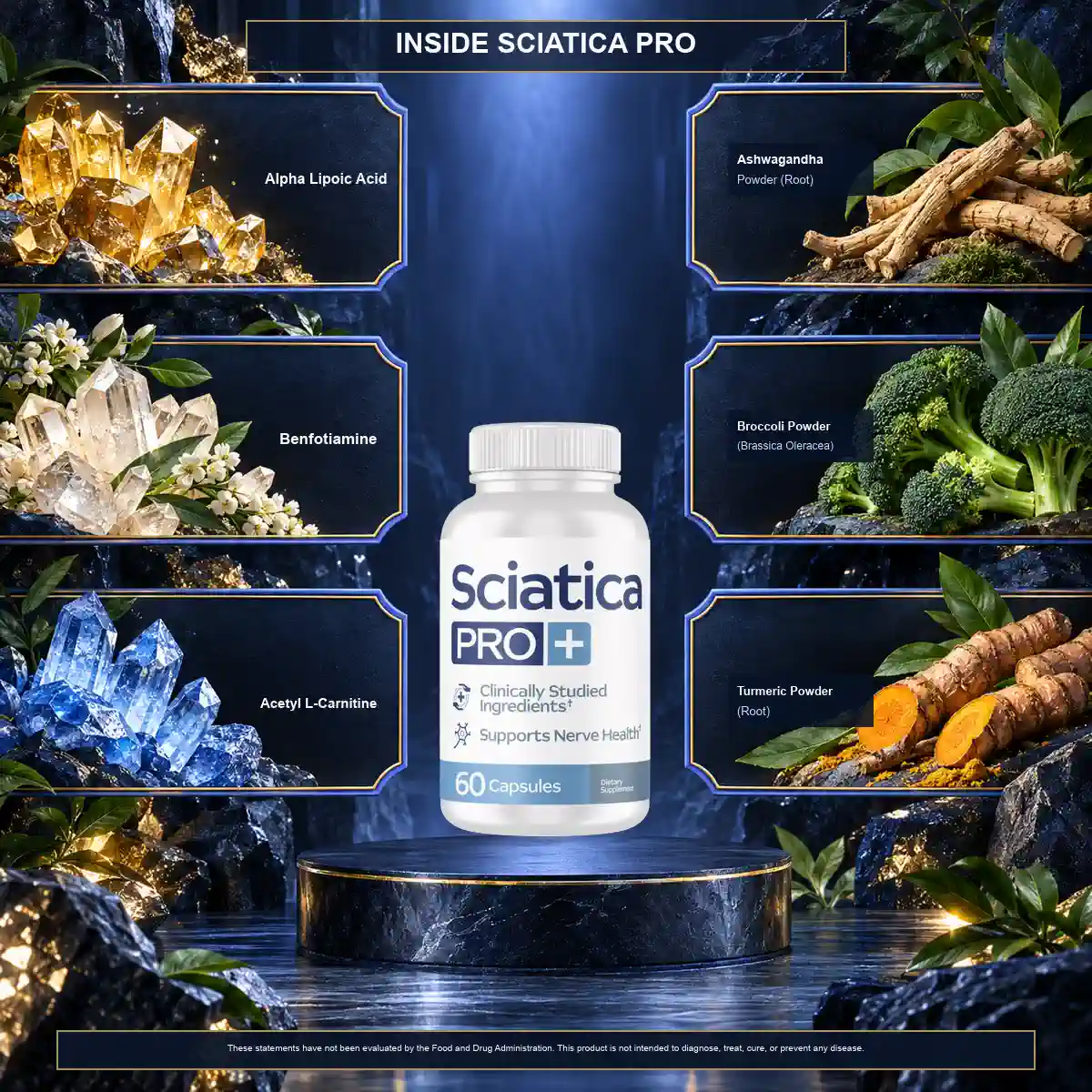
Three ingredients on the Sciatica PRO panel carry most of the weight of that front-of-bottle claim: alpha lipoic acid, benfotiamine and acetyl L-carnitine. All three have a real clinical literature, and it is overwhelmingly in diabetic peripheral neuropathy.
That is nerve damage caused by years of high blood sugar. It develops slowly, it usually affects both feet symmetrically and works upwards, and the mechanism is metabolic: sustained hyperglycaemia damages the small blood vessels feeding the nerve and the nerve fibres themselves. The supplements studied in it are being tested as metabolic interventions against that specific process.
Sciatica is something else entirely. It is pain along the sciatic nerve, caused almost always by mechanical pressure on a nerve root where it leaves the lower spine: a bulging disc, a narrowed canal, occasionally a slipped vertebra. It is usually one-sided, it often starts suddenly, and most cases improve over six to twelve weeks as the irritation settles (National Institute of Neurological Disorders and Stroke, “Pain”).
| Diabetic peripheral neuropathy | Sciatica | |
|---|---|---|
| What causes it | High blood sugar damaging nerve tissue over years | A disc or narrowing pressing on a nerve root |
| Where it is felt | Usually both feet, symmetrical, spreading upward | Usually one leg, following the nerve path |
| How it starts | Gradually, over years | Often suddenly |
| What it does over time | Chronic, progressive if blood sugar stays high | Most cases improve over weeks |
| What actually helps | Blood-sugar control and specific medicines | Staying active, physiotherapy, medical review |
| Is it a metabolic problem? | Yes | No, it is mechanical |
Two different problems, two different mechanisms, two different sets of treatments. Evidence for one is not evidence for the other, and a nerve is not a nerve is not a nerve.
Ingredient by ingredient
Here is what each of the three actually has behind it, with the amount on this label beside it.
| Ingredient | On this label | What was studied, and where |
|---|---|---|
| Alpha lipoic acid | 400 mg | Diabetic neuropathy, usually at 600 mg a day, sometimes intravenously. NCCIH describes the evidence as limited (National Center for Complementary and Integrative Health, “Diabetes and Dietary Supplements”) |
| Benfotiamine | 150 mg | Diabetic neuropathy, usually at 300–600 mg a day, with mixed results. Thiamine deficiency itself does cause nerve damage (NIH Office of Dietary Supplements, “Thiamin: Fact Sheet for Health Professionals”) |
| Acetyl L-carnitine | 50 mg | Peripheral neuropathy at 1,500–3,000 mg a day. One large trial in chemotherapy-induced neuropathy found it worsened symptoms (NIH Office of Dietary Supplements, “Dietary Supplements for Exercise and Athletic Performance”) |
| Vitamins B6, B12, folate, D3 | Ordinary daily amounts | Deficiency correction. A real B12 deficiency does cause nerve damage, and that is a diagnosis, not a guess |
| Ashwagandha, turmeric, broccoli | 25 mg each | Stress, inflammation and general wellness research at far larger amounts |
Note what happens when you put the amount and the study side by side. Alpha lipoic acid at 400 mg is in the neighbourhood of the studied dose. Acetyl L-carnitine at 50 mg is about one fiftieth of it, which means the trials it borrows credibility from are not trials of what is in this capsule.
Why this is legal, and why that matters less than you think
Nothing here is unlawful. Ingredient-level claims of this kind are ordinary in the supplement market, and the label also prints the required statement that the product is not intended to diagnose, treat, cure or prevent any disease (U.S. Food and Drug Administration, “Dietary Supplements”). The regulator’s line and the marketing line are both on the same bottle, in different sizes of type.
The gap the buyer falls into is not a legal one. It is the space between a technically accurate phrase on the front and a reasonable person’s reading of it, amplified by a product name that points at a condition. The label is careful. The name is not. And the name is what people search for.
See every Sciatica PRO amount, printed on the panel.
Check today’s priceHow to check any “clinically studied” claim in five minutes
Find which ingredients are meant
The label rarely says. Assume it means the two or three with recognisable research names, not the vegetable powder.
Search the ingredient plus “randomized” plus a condition
PubMed is free. You are looking for what condition the trials were run in, not for a verdict.
Write down the dose the trials used
It is in the abstract, usually in the first two lines of the methods.
Compare it with the label
This is the whole exercise. If the label is at 10% of the trial dose, the trial is not about your capsule.
Check who the participants were
People with diabetes, people on chemotherapy, healthy volunteers and people with back pain are not interchangeable.
Ask the seller for the citations
A company that ran or funded real research is usually delighted to send you the papers. Silence is also an answer.
What a fair version of the claim would look like
It is not hard to write an honest one. A label could say: “Contains alpha lipoic acid, studied in diabetic peripheral neuropathy at 600 mg daily.” That is longer, less exciting, and completely defensible. Some brands do it.
The reason most do not is that specificity invites comparison, and comparison is exactly what a vague claim avoids. Which is also why Sciatica PRO deserves genuine credit for the other half of its label: it publishes an amount for every ingredient, which is the thing that makes the comparison in this article possible at all. A blend would have hidden all of it.
The bottom line
“Clinically studied ingredients” means some ingredients have been in human trials. It says nothing about outcome, dose, or condition, and it is not a claim about the product you are holding.
For Sciatica PRO, the trials behind that claim were mostly in diabetic peripheral neuropathy, not sciatica, and two of the three ingredients are present at a fraction of the studied amounts. If you have diabetic neuropathy, the conversation to have is with your diabetes team. If you have sciatica, the conversation is with a doctor and a physiotherapist, and the label itself agrees with that.
Sources
- National Center for Complementary and Integrative Health. Diabetes and Dietary Supplements. NCCIH, current page. Checked September 30, 2026.
- NIH Office of Dietary Supplements. Thiamin: Fact Sheet for Health Professionals. NIH ODS, current revision. Checked September 30, 2026.
- NIH Office of Dietary Supplements. Dietary Supplements for Exercise and Athletic Performance. NIH ODS, current revision. Checked September 30, 2026.
- National Institute of Neurological Disorders and Stroke. Pain. NINDS, current page. Checked September 30, 2026.
- U.S. Food and Drug Administration. Dietary Supplements. FDA, current revision. Checked September 30, 2026.
Questions on this topic
More answers on the full FAQ page.
Does “clinically studied” mean the product was tested?
No. It is a claim about ingredients, and it does not say the finished formula was trialled.
What condition were the studies in?
Mainly diabetic peripheral neuropathy, which is nerve damage from high blood sugar, not sciatica.
Is sciatica the same as neuropathy?
No. Sciatica is usually mechanical pressure on a nerve root; diabetic neuropathy is metabolic damage to nerve tissue.
Are any studies cited on the label?
None that we could find, on the label or in the seller’s material.
Ready to try Sciatica PRO?
Pick a pack and see the price at checkout. The money-back guarantee is 60 days from purchase, unless the sales page prints a longer window. Questions first? Contact the order desk.
Sold through a U.S. stocking partner for Sciatica PRO. This site is not the manufacturer and earns when you buy.Keep reading
Label amount vs study dose
How to tell whether an amount on a supplement panel is a real dose or a token one, why “fa…
Read more →Vitamin B6 and nerves
Why vitamin B6 matters for nerves, why too much of it causes nerve damage, how B6 stacks a…
Read more →Sciatica PRO ingredients
All ten, with the amounts printed on the panel.
Read more →