From the blog
Vitamin B6 and Nerves: Essential, and Harmful in Excess
Vitamin B6 is essential for nerve function, and a deficiency causes nerve symptoms. It is also one of the few vitamins where long-term excess causes harm: high intakes over months can cause a sensory neuropathy of their own. The adult upper limit is 100 mg a day, and the risk is cumulative across every product you take, not per bottle.
What B6 actually does
Vitamin B6 is not one molecule but a family of them, with pyridoxal 5-phosphate as the active form the body uses. It is a coenzyme in more than a hundred reactions, most of them involving amino acids, and several of them matter directly to the nervous system.
It is needed to make serotonin, dopamine, GABA and noradrenaline, the chemical messengers nerves use to talk to each other. It is involved in making haemoglobin. It helps regulate homocysteine, alongside folate and B12. None of that is controversial, and it is why B6 appears in nerve formulas at all.
The adult Recommended Dietary Allowance is 1.3 to 1.7 mg a day depending on age and sex, and the Daily Value used on labels is 1.7 mg. Most people who eat normally get enough: it is in fish, poultry, chickpeas, potatoes, bananas and fortified cereals (NIH Office of Dietary Supplements, “Vitamin B6: Fact Sheet for Health Professionals”).
The unusual thing about B6
Most water-soluble vitamins are forgiving. Take more than you need and you excrete it, and the main consequence is expensive urine. B6 is the exception, and it is an important one for anyone reading a nerve-supplement label.
Long-term intakes well above the upper limit can cause sensory peripheral neuropathy: numbness, tingling and unsteadiness, usually starting in the feet and hands. The cruel irony is that these are the same symptoms people often take B6 hoping to relieve.
The cases in the literature generally involve gram-level doses taken for months or years, and most improve after stopping, though not always completely. NIH sets the adult tolerable upper intake level at 100 mg a day, which is about sixty times the Daily Value, precisely because of this (NIH Office of Dietary Supplements, “Vitamin B6: Fact Sheet for Health Professionals”).
| Intake | Where it sits |
|---|---|
| 1.3–1.7 mg a day | The recommended amount for adults |
| 1.7 mg | The Daily Value printed on supplement labels |
| 10–50 mg a day | Common in B-complex and “energy” supplements |
| 100 mg a day | The tolerable upper intake level for adults |
| Several hundred mg to grams a day, for months | Where the neuropathy cases come from |
Why stacking is the real risk
Nobody deliberately takes a gram of B6. What happens instead is arithmetic across bottles.
A B-complex might carry 25 mg. A “nerve support” formula might carry 50 mg. An energy drink or a pre-workout might carry another 20 mg. A multivitamin adds a few more. None of those individually looks alarming, and the person taking all four has never seen the total, because no label adds up anybody else’s.
This is the single most useful habit to take from this article: when you add a supplement, add up the B6 across everything you take. It takes one minute and it is the only number on most nerve labels where more is actively worse.
The B6 line on the Sciatica PRO label
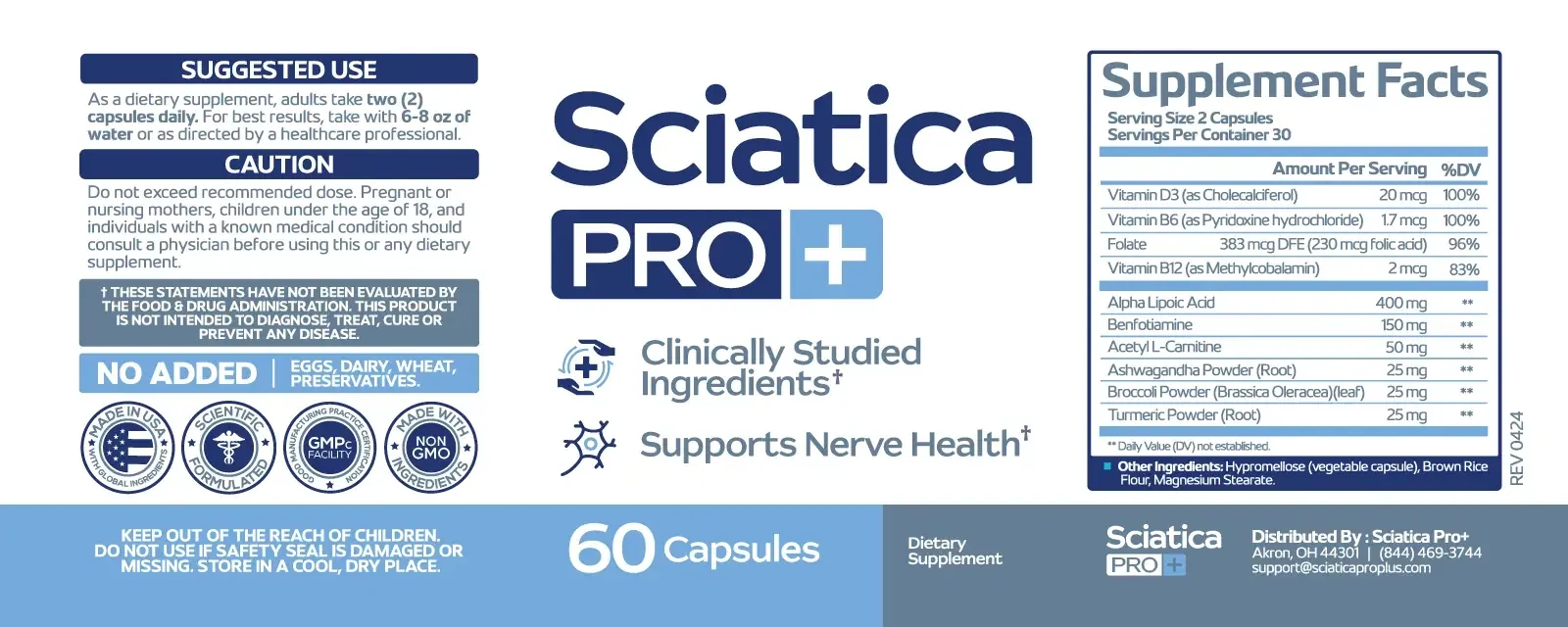
Which brings us to the specific reason this article exists. The Sciatica PRO Supplement Facts panel prints:
“Vitamin B6 (as Pyridoxine hydrochloride) 1.7 mcg — 100%”
The Daily Value for vitamin B6 is 1.7 milligrams. As printed, 1.7 micrograms would be one thousandth of that, or 0.1% of the Daily Value, not 100%.
| Reading | What it would mean | Is it plausible? |
|---|---|---|
| The unit is a misprint, and it is really 1.7 mg | An ordinary Daily Value amount, and the percentage is right | Most likely |
| The amount is right and the percentage is wrong | A trivial amount of B6, with an incorrect 100% | Possible |
| Both are right | Impossible; the arithmetic does not work either way | No |
We cannot tell which from a photograph of a label, so we publish both readings and draw no conclusion. It is a small error either way, and at neither reading is the amount anywhere near a level of concern.
It is worth a paragraph for two reasons. First, it is exactly the kind of thing a careful reader notices and then wonders what else was not checked. Second, on a product whose whole proposition is nerve health, B6 is not a random line to get wrong.
B6, B12 and folate: the trio worth understanding
The three B-vitamins on this panel work together, and the interaction between them has a genuine clinical consequence worth knowing about.
Vitamin B12 deficiency causes real, sometimes irreversible nerve damage, and it is common in people over 50, vegans, people taking metformin and people on long-term acid-reducing medicine (NIH Office of Dietary Supplements, “Vitamin B12: Fact Sheet for Health Professionals”). It classically shows up first as a change in the blood, which is what prompts testing.
Folic acid can correct that blood change while the nerve damage carries on underneath. This is the reason folic acid fortification is capped, and the reason anyone with unexplained nerve symptoms should have B12 measured rather than supplemented blind (NIH Office of Dietary Supplements, “Folate: Fact Sheet for Health Professionals”).
See every amount on the Sciatica PRO panel.
Check today’s priceHow to read any B6 line on a label
Check the unit
mg or mcg. They differ by a factor of a thousand, and labels do occasionally get it wrong.
Check the percentage against 1.7 mg
If the panel says 100%, the amount should be about 1.7 mg. If it says 2,000%, you are looking at roughly 34 mg.
Add up every product you take
B-complex, multivitamin, energy formula, nerve formula, pre-workout.
Compare the total with 100 mg a day
That is the adult upper limit, and the risk is about months, not single doses.
Ask about the form
Pyridoxine hydrochloride is standard. Pyridoxal 5-phosphate is the active form; the neuropathy cases are mostly with high-dose pyridoxine.
If you have nerve symptoms, tell your doctor what you take
B6 neuropathy is diagnosed by asking, and people often do not mention supplements unless prompted.
What this does and does not say about the product
To be clear about the conclusion: the vitamin B6 in Sciatica PRO is not a safety concern at either reading of its label. At 1.7 mcg it is negligible. At 1.7 mg it is the ordinary daily requirement. Neither is close to 100 mg a day.
The caution in this article is about the habit, not this bottle. People with nerve symptoms are exactly the people most likely to be taking three or four overlapping B-vitamin products at once, and that is where the arithmetic starts to matter. A nerve supplement is a sensible place to raise it.
And the misprint is worth flagging because a label is a document. If a reader cannot trust the units on the vitamin block, the natural next question is what else went unchecked, and that question is fair even when the answer turns out to be nothing (U.S. Food and Drug Administration, “Dietary Supplements”).
The bottom line
Vitamin B6 is essential for nerves, and it is one of the few vitamins where long-term excess causes the very symptoms people take it for. The upper limit is 100 mg a day and the risk accumulates across products, not within one bottle.
The Sciatica PRO panel prints its B6 line in micrograms where the Daily Value is in milligrams, which looks like a unit misprint. At either reading the amount is small and safe. The habit worth keeping is the one this article is really about: add up your B6 across everything, and get a blood test before you treat nerve symptoms with a capsule.
Sources
- NIH Office of Dietary Supplements. Vitamin B6: Fact Sheet for Health Professionals. NIH ODS, current revision. Checked September 30, 2026.
- NIH Office of Dietary Supplements. Vitamin B12: Fact Sheet for Health Professionals. NIH ODS, current revision. Checked September 30, 2026.
- NIH Office of Dietary Supplements. Folate: Fact Sheet for Health Professionals. NIH ODS, current revision. Checked September 30, 2026.
- U.S. Food and Drug Administration. Dietary Supplements. FDA, current revision. Checked September 30, 2026.
Questions on this topic
More answers on the full FAQ page.
Can vitamin B6 cause nerve damage?
Yes, in long-term intakes well above the 100 mg a day upper limit. The symptoms are numbness and tingling, usually in the hands and feet.
How much B6 do adults need?
About 1.3–1.7 mg a day. The Daily Value used on labels is 1.7 mg.
Why does the Sciatica PRO label say 1.7 mcg?
It appears to be a unit misprint: at 1.7 micrograms the percentage could not be 100% of the Daily Value.
Should I get a B12 test before taking a B supplement?
If you have unexplained nerve symptoms, yes. Folic acid can mask the blood signs of a B12 deficiency while nerve damage continues.
Ready to try Sciatica PRO?
Pick a pack and see the price at checkout. The money-back guarantee is 60 days from purchase, unless the sales page prints a longer window. Questions first? Contact the order desk.
Sold through a U.S. stocking partner for Sciatica PRO. This site is not the manufacturer and earns when you buy.Keep reading
“Clinically studied” — for what?
What the phrase on a supplement bottle does and does not promise, and which condition the …
Read more →Label amount vs study dose
How to tell whether an amount on a supplement panel is a real dose or a token one, why “fa…
Read more →Sciatica PRO ingredients
All ten, with the amounts printed on the panel.
Read more →